

With the release of their third frame, the dirt-jump orientated Fade, Pete chats developing the bike with Ed and James at Airdrop Bikes.
Developing a new frame is never a straightforward process, especially for a small brand like Airdrop Bikes.
With two frames already under their belts in the form of the Edit and Bitmap, Pete chatted through the process of bringing the Fade from concept to reality.

Where did the inspiration for the Fade come from?
James: We wanted DJ bikes to ride. Airdrop was never supposed to be about making bikes that sell; more about making bikes we want to ride and then fingers crossed people buy them.
Ed: Initially we said we’d work up a quick design and get a couple of prototypes made for ourselves, and maybe just leave it there. I should have known better. We became so invested in designing those first prototypes that they were almost production ready.
During testing everyone that got involved was stoked on the whole project which motivated us to bring the Fade out officially. A bit of a risk maybe, but I didn’t set up Airdrop to play it safe the whole time.
What did you know you did and didn’t want to do with this bike?
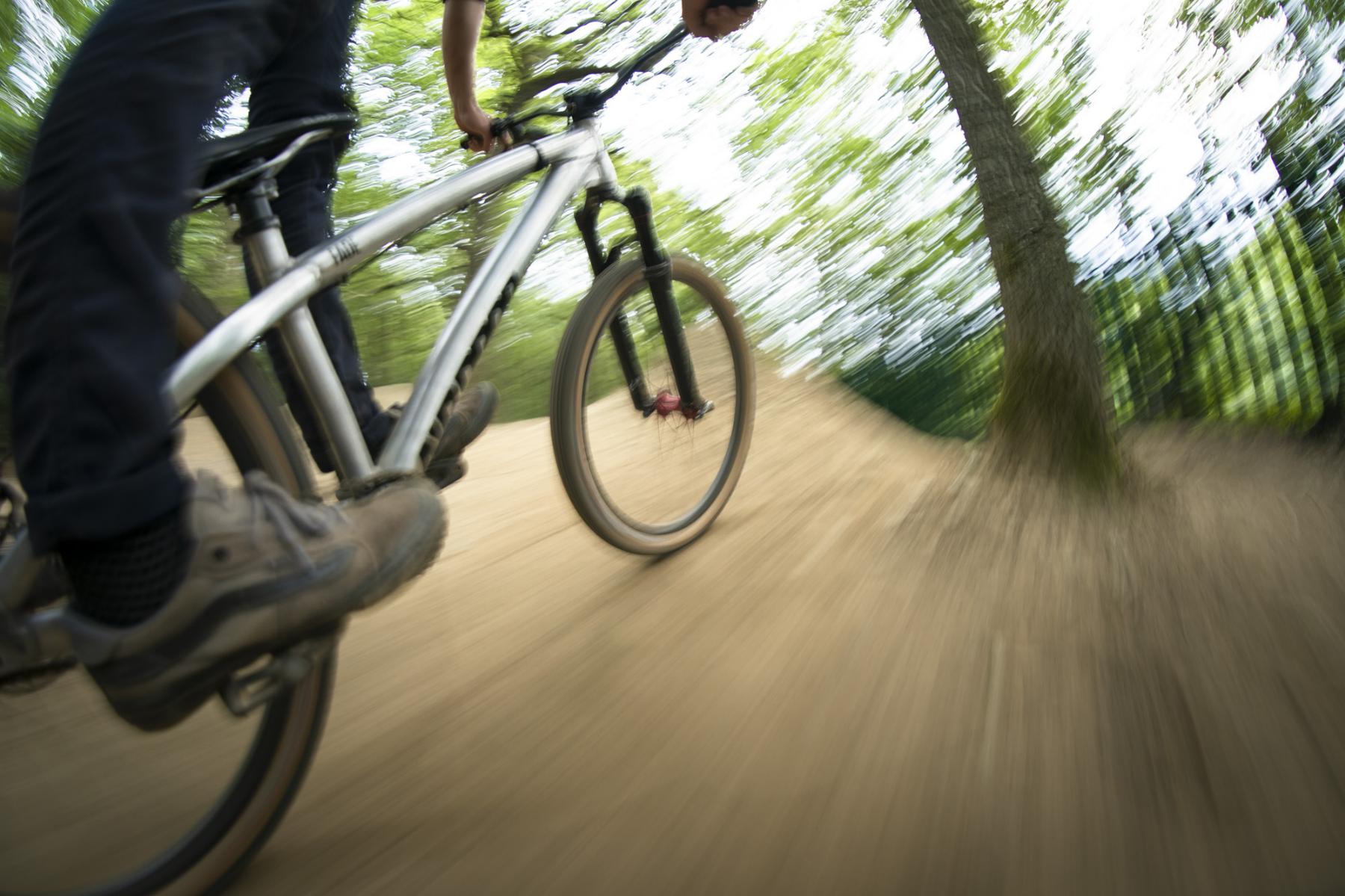
James: We definitely didn’t want to over complicate things. That’s why we went with single-speed only horizontal dropouts, no ISCG tabs and brake only routing. We’re aware some people may be put off by the fact they can’t run their old through-axle 26” wheels and others might want to run gears but in my opinion all that detracts from the bike’s purpose.
Ed: To me it had to be a legitimate dirt jump bike, plain and simple. The kind of bike any proper dirt-jumper would be into riding; not a modified version of something else, or a bike designed to be ‘versatile’. So we started with first principles: it had to be as clean and as minimal as we could make it.
Just dialled geometry and those few features dirt jumpers need, but nothing else. They say if a thing’s worth doing, it’s worth doing right, and that’s a principle we try to stick to with everything we do.

How has having the Edit under your belt made the Fade harder or easier to come by?
James: I guess the Edit established the business. Without the Edit I wouldn’t have the job.
Ed: Designing the Edit and bringing it to market was an incredibly steep learning curve. Then of course we released the Bitmap alloy hardtail. In the last couple of years we’ve developed a great relationship with our suppliers; there’s a lot of trust there and we work together well.
So we now have partners that can help us to realise our designs really effectively and that’s encouraged us to be bolder in what we’re doing. We’re also that bit more established as a brand and a functioning business so we feel like we can risk something more specialised like the Fade.

A hardtail is very different from a full suspension frame, what did you learn with the edit that could be carried over?
James: Very little directly. As you say both bikes are completely different so nothing is shared. I guess it’s not really what we learned specifically from the Edit but more about working better with our manufacturer in Taiwan.
It’s one thing to design something here in Sheffield but to then work with suppliers to come up with the best way to produce that part and accurately communicate exactly what we want to someone who’s first language isn’t English can be a challenge. But that’s all part of it and we have a really good relationship and are always pushing each other to make things better.

Ed: I agree with James but I’d also add that we’ve learned a lot about the materials and processes, which means we’re much stronger in the industrial-design elements of each bike than we were originally. I feel like we’ve always had our geometry, aesthetics and layout dialled but we’re now much closer to the engineering and production than we were before.
Developing the Bitmap was a stepping-stone to the Fade, and although no part of the design is the same, all the bikes share some Airdrop DNA. When you see them together they look scarily like we’ve got a bike range.

Did you have a material in your head before you started?
James: Yeah alloy. We wouldn’t make a bike in alloy if it was the wrong thing to do but Airdrop is very much an alloy bike brand. I’m not saying we will never use other materials but it’s definitely the material we have the most experience with.
And besides all that I would say alloy is without a doubt the best material for this application, from experience steel DJ bikes lack that fizz/energy you get with alloy.

Personally I’m lukewarm on steel. It seems like steel has a nostalgic appeal and it’s having a bit of a renaissance, but when I was growing up all the rad bikes were alloy. I’m not a massive fan of the ride characteristics and I think in some cases it’s being used for bikes that it’s not ideal for.
Ed: The Fade was always going to be alloy. We’re making these in relatively small batches with a lot of CNC machining, and it’s easy to manipulate tubing and butting to tune the frame in the way that you want. But apart from that, I think it’s the best material for a bike like this, especially with the quality of trails we have these days.

How difficult was it to try and future-proof this frame?
James: We don’t attempt to future proof any of our frames. I don’t really believe in future proofing; I don’t have a crystal ball. I’m not Mystic Meg and cannot predict what the future holds so definitely can’t design a bike around some non-existent thing. Bolting on removable dropouts just in case isn’t future proofing.
I think customers should be questioning the logic of future proofing and bikes that work with different standards. In my opinion it’s just a way of increasing consumer confidence after the proliferation of new standards in the last few years. I think “future proof” means a design that isn’t quite as good as it could have been. Don’t get me started on bikes that accommodate different wheel sizes.

Ed: It wasn’t a consideration at all. For me the most important thing is making the bike the best it can be right now. Even if we did have that crystal ball and we knew what changes are round the corner, the bike could either be right now, or right in the future – not both. And since we’re making these in fairly small batches, we can change things up if the future really does hold something better.
I understand the desire for so-called “future-proofing” but it’s only relevant if you believe that your current bike becomes obsolete as soon as something new comes out. Whereas it’s really just as good as it always was.

Was picking a wheelsize an issue?
James: Not at all. 26” is still king for DJ.
Ed: You can bet that there are DJ bikes in development with 27.5” wheels right now. And maybe that makes sense if you want to market them as bikes you can also use for 4x race, but I’m not generally in favour of compromise designs. 26” is the best wheel size for an mtb dirt-jump bike, so that was the decision and we didn’t seriously discuss an alternative.

How many prototypes did you have before getting to the production Fade?
James: The design went through seven iterations, which included two physical prototypes and a few 3D printed parts to refine the design in some areas. The geometry was largely unchanged throughout the whole process. We were pretty close on at the first round of samples, but went through some tube butting tweaks, cable routing tweaks and a lot of work on the dropouts with the integrated tensioner.
Ed: As a small brand, we put in a lot more design-time before going to first prototypes than bigger companies would; we can’t really afford to just smash out a rough mule to get started. Plus the ability to 3D print parts quickly and cheaply these days means it’s not essential to produce full physical prototypes with every iteration.
That’s invaluable for us since we’re aiming high with the quality and performance of our bikes despite having limited resources. We’re not working to a rigid plan so a bike only gets signed off when it’s good and ready… However much development that takes.

Beyond the development of prototypes, what form did your testing take?
James: The majority of testing has been rider testing. I’m a big believer in rider testing; software and machine work can’t tell you the important stuff like how the bike feels. It’s always great to get other people to ride the bike but I think it’s super important to put the rider testing in yourself too, that way you better understand any issues and get a feel for the whole thing.
It’s pretty unique at Airdrop to be so involved with every step of a project from the idea and brief through development to production and then building customer’s bikes.
I would like to think being so involved in every part of the process gives us some kind of advantage over bigger companies where you’re more out of touch with certain parts of the business. I’ve been riding the prototypes now for over a year, just been trying to get as much time in as possible on them skatepark, trails and BMX track.

Ed: James is right, there’s no substitute for getting out on the bikes. But I would also add that we put the frames through all the relevant fatigue and impact tests independently in the UK so they’re properly certified.
And before we even made the first sketches, we canvassed a load of feedback from riders as to their preferences on geometry, their bugbears with their current bikes and what they’d like to see improved. That’s where you get those priceless nuggets of information that can be the difference between a good bike and a great bike.

Will you be going for the small batch approach again?
James: Yeah its batch production, 50 in the first batch. 50 probably doesn’t sound like many but to us that’s a lot, its just the two of us and we have some kind of contact with every customer so 50 people on a Fade would be huge for us. Finger crossed it goes well because developing and launching a DJ bike is probably not the most sensible thing to do.
Ed: Batch production is going to be the way for the foreseeable future. Yes it’s more costly than mass production but it comes with plenty of advantages, which we try to make the most of. For example we’re able to change up designs more quickly this way if we want to, we don’t need to operate model years and we’re not sitting on new-old stock that needs to be discounted and disposed of.
And it’s worth remembering that for us, 50 or 100 frames is a massive financial commitment. We’re not trying to get rich quick; we’re not looking to hit a price point or find that extra 1% of margin. All we’re trying to do is make the bikes as good as they can possibly be and if we do that, success will take care of itself.

Where next for Airdrop? How do you plan to go about getting extra helpers etc. etc.?
James: More rad bikes we want to ride.
Ed: Airdrop is in a really good place, but we’re only three years in so it’s nowhere near what I want it to be. There are a lot of good things to come, if only I could show you what’s in the pipeline…
We’re still a micro-brand really, and staying independent is important. We probably won’t have the money to do everything we want to; everything has to be earned. But that’s ok, it just means every new Airdrop bike will have to be sick.


