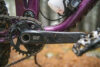
Shimano launched their updated Di2 drivetrains, producing their first proper wireless 12-speed mountain bike offerings in XTR, XT and Deore flavours.
Replacing the rather tired mechanical XT drivetrain on his Saracen Ariel 60 Elite, the new Shimano XT Di2 graced Pete’s long term test rig, to go back to back.
Photos by Pete Scullion.

A few weeks after launching their new XTR Di2, Deore XT and Deore Di2 followed. Shimano’s first full wireless drivetrains had arrived. Whilst XTR remains the all-singing, all-dancing groupset, Shimano XT remains that stalwart option that combines performance with a bit more longevity.
With the XT Di2 you get an alloy cage compared to XTR’s carbon fibre number. Shadow ES technology, impact recovery, battery integration and protection of its bigger brother remains. A wired EMTB option is available as well as Linkglide too.
The Di2 battery is integral to the mech rather than attached to the reverse like on certain SRAM groupsets. Also, with B tension and limit screws staying on the mech, you can set it up the old fashioned way as long as you have the right sized allen key.
Hollowtech II arms and steel axle mean that the cranks remain very much the usual fare. Tried and tested. You only get one set of cranks on offer with XT Di2 though. You get a 176mm Q-factor, 160 to 175mm arms in 5mm increments, 55mm chain line and chain rings from 28 to 36t.

The shifter looks to offer all the mounting and adjustability options of the XTR. There’s also less of a move towards buttons, with the paddles having a positive primary and secondary click. At present though, fans of Rapidfire triggers will be disappointed, the shifter is thumb only. The double click function can’t be disabled on the XT shifter.
Functionality remains the same as XTR, you just get heavier materials. Alloy instead of carbon bodywork and steel bolts. On trail, you’ll likely struggle to notice the difference but your wallet will certainly notice it. The cassette looks familiar enough but has gone on a minor diet and gains new teeth profiling.
An XT Di2 mech will set you back £429.99, the shifter £159.99, £149.99 for the cassette, £39.99 for the battery and £29.99 for the charger. Total is £809.95. Price for cranks were not in the original pricing we saw, but with SRAM XO transmission, XT’s main competitor, being £1700+, the cranks will have to be made of solid gold for this not to be a considerable saving.

Fitment was as you would expect with modern Shimano MTB drivetrains, with the added bonus of not having to route a cable through a frame at any point. In fact, this is one that with the right BB tool, I could even do myself. Everything looks and feels Shimano, rather than being a complete departure from the mechanical counterparts.
Most obvious is the chunkier rear mech and shifter to contain the batteries and telekinesis apparatus contained within. The shifter paddles feel familiar but the main difference here is the lack of Rapid Fire trigger shifting. It’s all thumb work with the XT Di2, something I lament the loss off. Sometimes that index finger action is exactly the right tool for the job, usually when stood up and sprinting.
What remains is the positive clicks of the mechanical shifting, with there being primary and secondary clicks. The latter offering continuous shifting in the direction set for as long as it is held. This may be a way to offset the lack of trigger but in all honesty I have yet to use it for that.

Any fine-tuning can be done through the Shimano E-Tube app. Shift profiles, button actions, battery levels, you name it. The lack of cable tension needed adjustment after fitting means that I have yet to even download the app. The shifting has been the same crisp action since day one that it is today. This is aided by the fact that despite some atrocious weather and riding conditions, neither the chain nor the cassette have shown the slightest signs of rust, with or without post-ride lube.
A day prior to writing these words, I hung the mech up on a large piece of local stone that I usually avoid. Keen to keep my riding buddy far behind I opted for a questionable line that I rarely indulge in. Cue that awful sound of metal glancing rock, I winced, before continuing onward as if nothing had happened. The two concentric springs that replace the ‘classic’ clutch did sterling work of allowing the mech to twang away and reset. Magic. It didn’t even have the scars to prove it.
Battery-wise, XT Di2 went on my Saracen in early October. It’s been in use since then. The day I clipped the rock (January 12th) was also the day that the battery finally gave out. Three months and three days after it was fitted, with near daily use since and I was stuck in third. The battery went in the charger and went back in the mech. I have scheduled another charge for early March.
Once you’ve done the battery removal once, it’s way easier than expected. As you can’t see the battery, being internal, it’s less intuitive. Press the lock towards the front of the bike, remove the covering, release the latch holding the battery in and it’ll drop out. It’s unlikely you’ll be doing this in the wild, but best keep a hand under the mech so that it doesn’t go AWOL. Charging is fast enough, but not enough to save the day should it go flat on you.
You can check out the Shimano XT Di2 drivetrain over on their website here.